












By John Loughery, of the Berlin Land Trust
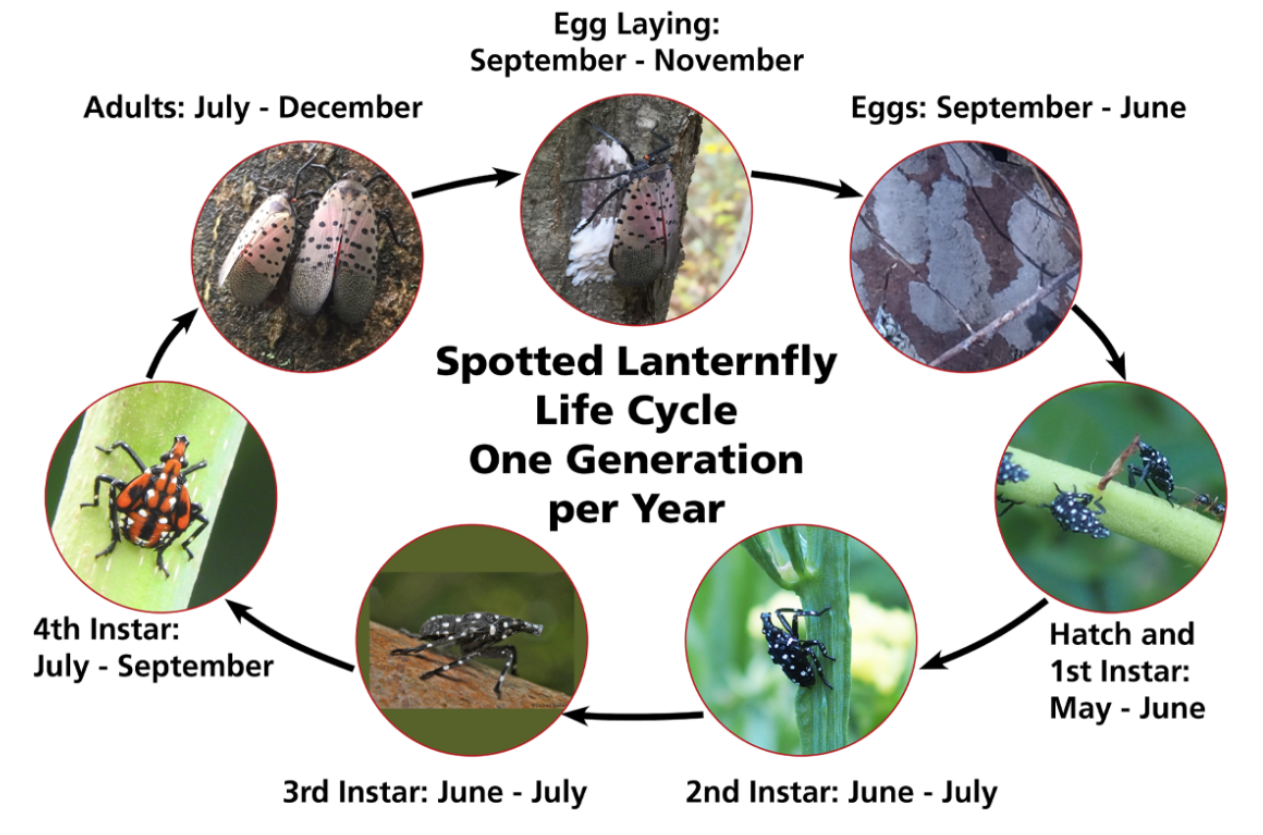
To view an enlarged version of this image on the Cornell College of Agriculture and Life Sciences website, click here.
The spotted lanternfly, a particularly beautiful, plant-hopping insect with a fiercely destructive nature, was unknown in the U.S. prior to the 2010s. September will be the crucial month. That is when spotted lantern flies deposit their eggs on tree bark, covering them with a thick white or gray-ish substance. It is necessary to scrape that substance off the tree, immediately killing the eggs, or vast numbers of these insects will be released into the environment in the spring, endangering plants and trees in that area. So, the message is: examine your trees!
Indigenous to China and Vietnam, The Spotted Lantern Fly allegedly arrived in the U.S. aboard a cargo ship from Asia in 2014 and slowly spread out across Pennsylvania and New Jersey, wreaking havoc on crops, plants, and trees in those two states. (Images are abundant on Google and YouTube.) It made its way into New York State a few years ago and was the source of major concern in New York City in 2022 as a threat to the city’s many parks, and now residents of Berlin have noticed its presence in central CT.
You can’t mistake the spotted lanternfly for any other insect. The adult flashes bright red beneath its tawny spotted wings, often with a snippet of blue visible as well. The U.S. and the CT departments of agriculture ask that any sightings be reported on their website so that the advance of these insects can be tracked. Just as importantly, these government agencies ask anyone who encounters them to kill them immediately. They reproduce at a significant rate and can congregate in astounding numbers. (Certain YouTube videos are not for the squeamish.) It is also important to know that any contact with them is harmless to individuals: they represent no health threat to humans. They don’t fight back.
According to the EPA, there are no sprays or other effective industrial means to deal with this problem, but the spotted lanterfly is very easy to kill. When it lands on a tree trunk, it remains there for quite some time; a quick smack with a stick, shovel, rake, or any solid object will end its life. When it lands on the ground, one stomp of a foot will take care of it.
Another reason spotted lanternflies are easy to kill is that they have a very limited flight capacity; they usually fly no more than a few feet before they need to land on a tree or on the ground.
A secondary problem with the arrival of the spotted lanternflies in anyone’s backyard is that they secrete a honey-like substance onto the bark of the tree they have landed on. As a result, one Berlin resident noted a significant influx of bees in his yard hovering around these trees. Releasing a jet-spray hose of water along the bark, from its base to several feet above the ground, does, at least temporarily, eliminate the substance that is attracting the bees.